Showing posts with label Mike Moore Leadership. Show all posts

Moore's Law Of Achievement


The best way to improve your results
is to focus on the things that cause your results, not your results.
Leadership and Coaching Tip...
Leaders who coach, install attitudes, teach skills and manage actions,
all to come back to the attitudes that drive the actions.

Coaching To Become A Game Changing Leader!

There’s lots of talk, workshops and articles written today about coaching and leadership. I’m always interested in what people are saying about coaching and leadership because I’ve been studying both all my life. The importance of leaders who coach is heightened in today’s hyper-competitive job market and rising employee dissatisfaction.

The latest research reveals that only 11%-22% of employees are passionate or fully
The ABCs Of Leadership, Always Bea Coaching!
engaged with their work, 67% of employees think about leaving their job daily, 67% of employees earning $100,000 or more annually are planning to leave their job in the next 6 months and 37% of employees are actively looking for a new job. Exit interviews long ago exposed that employees don't leave bad jobs, they leave bad bosses. This situation is getting worse and developing leaders who can coach, inspire, enlighten and empower people to help them learn, grow and improve is more important than ever. 

I recently heard an interview with Hall of Fame Football Coach Bill Parcells which explained a lot to me about my own life. The interviewer was given Bill Parcells credit for his coaching tree, the coaches that worked for him who have gone on to great head coaching careers, coaches like Bill Belichick and Mike Zimmer. He quickly cut off the interviewer and said it wasn’t so much his influence as it was the fact that he hired coach’s sons. He explained that coach’s sons were raised differently, from a very young age, all they heard about was coaching. They were exposed to inside information and got to watch how coaches worked.

The reason this resonated with me is that I am a coach’s son. I was raised to coach by a very successful High School Football Coach, and in addition, by my Mother who was an outstanding teacher. So, you see education and coaching was all I heard about growing up. I was exposed to the great coaches of the past 70 years. I was fortunate enough to hear many speak and sit in on conversations between coaches about how to coach, build teams and bring out the best in people. My earliest memory of being consciously taught about coaching goes back to when I was 9 years old, but I had already spent several years in my Dad’s coach’s office, film room, locker room and sidelines watching him coach. At the age of 9 however, my father started talking to me about what I was watching. He began to teach me to be a coach.

44 years ago, I made the choice to forego a career in sports and go into sales and business. I took all the early life lessons and my understanding about coaching into business.  I continued to study coaching and adapt and apply what I had learn to business and sales leadership. I adapted and developed programs that effective created results others were not getting. Make no mistake, business and sales coaching are different than sports coaching, in fact they are harder, and in my keynotes, workshops and coaching session I share the similarities and differences and how to become a real Business Leadership or Sales Leadership Coach. As I began speaking and coaching full time, and after my father passed away, I was blessed to have the legendary Hall of Fame Coach John Wooden spend time with me. He shared his insights and experience freely and we talked about the differences between business, life and sports coaching.

Over the years I’ve seen many great coaches speak about coaching and I’ve heard many business leaders speak about coaching in business, but I always get a sense that they are missing pieces and not connecting all the dots. I am now more aware of why I can hear these missing dots and connect them. looks like an opportunity to coach and create improvement. Improvement, that’s key to coaching. In fact, being obsessed with improvement is one of my 11 Keys To Great Coaching from my ABCs Of Leadership…Always Be Coaching! 

It’s with all that I’ve been exposed to and experienced that I developed my ABCs Of Leadership…Always Be Coaching, keynotes, workshops, leadership development programs and coaching sessions. This includes my 11 Keys to Great Coaching and I’m excited to be doing a Spotlight Session to kick of this year’s International Business Show. On Tuesday February 19, at 9:30am in South 223 I will be sharing my insights to inspire, enlighten and empower leaders to become the coaches who can attract, retain and develop the teams and talent to help them and their companies stand out and be a game changer! 

You see my normal upbringing wasn’t so normal, I was blessed to take an exceptional journey that exposed me to both sports and business coaching up close and personal. In homebuilding we’ve all hear the analogy that if you’re a hammer everything looks like a nail, well I’m a coach and to coaches everything looks like a chance to coach and create improvement. So, if you want to learn the 11 Keys To Great Coaching and always be creating improvement that leads to excellence join me at IBS 2019 and I’ll share why Bill Parcells explained that a coach’s son is just different and how you can be too and how it will change your career and improve your people and company!

By Mike Moore

Being The Boss


Be courageous, it's not easy to do the right thing. It takes a large heart filled with love and genuine caring for your people. Remember love holds people accountable to be their best self and to keep improving that best self. You have been given a great responsibility to serve and care for the people who work for you. Give them your best and your business will be blessed and grow. Then you'll be given even more opportunity to care for more people. It's also important to keep in mind your business cannot improve unless your people do.

Go be the boss, someone has to lead if people are to overcome their mediocrity, come together and be part of something extraordinary! You've all seen it and been part of it in your past, now share it and help your company be that kind of place!

Last, remember they're going to challenge you because they want to see if you mean what you say. Be prepared to stand strong and remember as leaders you are the lowest form of behavior you except and tolerate.

Be your best!

By Mike Moore

7 Up's To Peak Performance

Rise Up…Start and end each day with grit, determination, gratitude and a smile! Put a bounce in your step and energy in your voice!

Show Up…Arrive early and be prepared with the right intention and purpose.

Reach Up…Set high expectations and only accept your very best. Keep learning, growing and improving.

Listen Up…People will know you care about them, and trust you, if you’re listening with the intention to help, serve and do what’s best for them.

Stand Up…Be courageous! Ask the difficult questions and be willing to serve people, not please people. Be the expert by sharing your knowledge and experience to help them do what’s best for them.

Warm Up…Be helpful. People will feel what you feel and believe what you believe. Be caring, kind and courageous. Difficult situations and people require more time, courage and expertise…Be gracious and friendly but firm in your conviction to do what’s best for them.

Follow Up…Follow through! Do what you say you will do. Stay in touch and leave people knowing you care about them and are there to help them. Always do a little more than you promise…Go the extra mile!

By Mike Moore

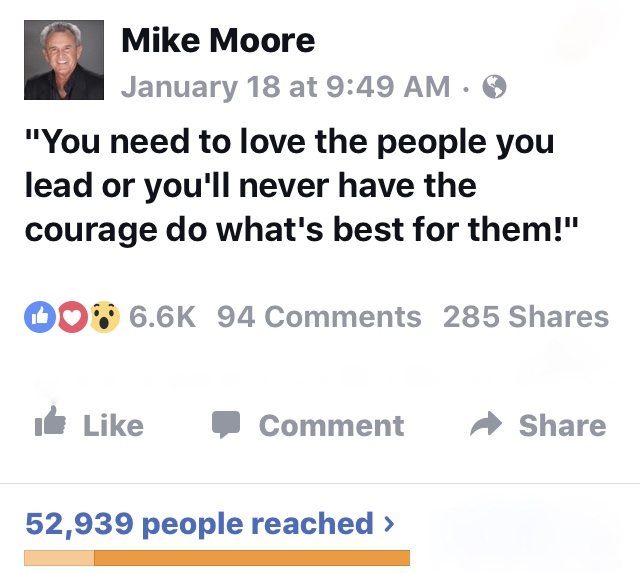
Real Leadership Is An Act Of Love!

Leaders pay attention, people will respond to your challenge is your challenge is made because you love them and want the best for them. #MooreThoughts #Leadership

Employee First Leadership


The customer is always right. How far off course did we go following this mantra? I think most people in business and sales can explain what this philosophy was intended to produce and yet we've all witnessed the unintended consequences and damage this has
done to the buyer and seller relationship.

This attitude came from our desire for instant gratification which never generates the best results. Do whatever it takes to make sales became the strategy in the, 'Just win baby! and 'Just Do It!' age of business. To win today, the mantra needs to shift to, 'Just Do It Right', but first let's look at the unintended consequences before we talk about how to become the leader who can reverse their effects.

The unintended consequences...
If the customer is always right, then the employee is always wrong. Imagine going to work and knowing you will always be wrong...Very demoralizing.

A dysfunctional relationship between buyers and sellers occurred during, 'The Customer Is Always Right' age. Buyers became much too entitled and salespeople focused on making a sale, not doing what's best for the buyer or making customers.

The focus on making new sales, not customers, caused buyers to feel that salespeople were more concerned about the transaction than they were about them or the outcome they wanted. Mistrust grew between buyers and salespeople. Both sides didn't trust the others intentions.

Salespeople, customer service and executives became afraid to tell buyers no, walk away or look for a better opportunity to do good business. Business is all about connecting with people who can help each other and it needs a healthy trust between buyers and sellers to grow and be profitable.

People were actually treated poorly. Employees were abused and buyers indulged to the point they became spoiled, non-compliant buyers who couldn't be satisfied, sold at a profit or become loyalty customers.

Employees began to not trust their own companies. The belief that the company really didn't care about them or the buyer grew. They started to feel that the company only cared about making a profit. Don't get me wrong, leaders need to make sure their company is profitable or they won't be around to care about people. However, if people are their company's greatest asset then they need to act like it.

The phrase 'Do what's best for the buyer' was, and in most cases still is, interpreted as, 'Do whatever they want' to get them to buy or go away if they are complaining.

We intended to improve customer service by pleasing the buyer.  Instead, spoiled consumers soon had no loyalty. This reduced their buying decision to the lowest price which usually didn't result in what was best for the them, creating more dissatisfaction. This became a vicious cycle and war broke out between buyers, sellers and companies.
We talked about customer satisfaction, spent millions on surveys and customer retention programs while our intention and focus to make new customers (sales), offended our existing customers.
None of this is part of a good business plan which created many unrealistic expectations that could not be met.

Business historians will surely look back and write about how foolish 'The Customer Is Always Right' age of business was and the mess we made of business relationships during this period. We chased short term gains and created long term disaster!

Now it is time for the 'People First Age of Business' and the good news is that the results can be the longest most sustainable economic boom in history.

To lead your business to a healthy, profitable and sustainable place your people will need to
be more important than your customers. That's right, 'Employee First Leadership' starts with your people, then you can create a 'Customer First Company'. When employees are happy, energized and challenged they are better prepared to make and keep customers by doing what's best for them, not just selling them, but truly serving them.

'Employee First Leaders' do what's best for the people who work for them, and then ask them to always do what's best for the buyer to make them a customer.

A 'Customer First Company' makes customers, not just sales. Doing what's best isn't always what the buyer wants but what's in their best interest. This holds true with your employees as well. What's best for them isn't always what they want but it's a leaders responsibility to serve people, not please people. Serve your people and ask them to serve others and make customers and your sales, revenue and profits will increase. In addition, you'll create long term sustainable growth.

I knew an uneducated man, a high school drop-out, who ended up owning a car wash.  He left for lunch one day and left his son in charge.  When he returned from lunch he found his son at the booth taking new customers money.  The line of cars to wash grew longer.  They seemed busy with lots of new customers and the son was happy.  The son felt good as he talked with the new customers waiting to get their cars washed and the line continued to grow. The father took the son aside and explained that it's easy to take people's money but the most important part of the business was to keep them coming back. He further explained that it only happens because of perfectly washed cars.

He made the point to his son to stay focused getting the cars washed and keeping the line moving. I said he was uneducated, I didn’t say he wasn’t smart.  The memory of this event comes to mind even when I am working with large corporations, industry leaders and multi-million dollar companies. 

He was explaining 'Employee First Leadership' without knowing it. It's always more important for a leader to spend their time with the people who make customers because customers come back and send other people to your business ready to become new customers. In addition, word of mouth spreads virally in the social age and allows 'Customer First Companies' to establish their brand and grow faster.

This is 'Employee First Leadership' and it works for all businesses and organizations. Make the people who serve your customers more important than new sales and your business will prosper and grow. 

By Mike Moore

Locker Room Leadership

I've learned many things from great coaches about leadership. The first and place becoming a winner starts...Winning is about more than the score. 

Coaches who win are leaders, and leaders don't measure winning by the scoreboard. They measure winning by the positive effect they have on people's lives. Don't misunderstand what I'm saying, anytime they keep score, it's important to play to win. Playing each game, day or event in life to win, making the effort, exhausting oneself in the pursuit of a worthwhile cause, is what exposes the opportunities to learn, grow and become the person who can win the bigger battle of developing into a lifelong winner.

Leaders, coaches and mentors view the score as a lifelong process, a marathon not a sprint. Don't ask them what today's outcome was...Ask them in 10 years how the people they led are doing, judge them by how they have influenced the people they led. Vince Lombardi, yes the one the trophy is named after, once said, "The most difficult thing I do is getting them ready to play each week". Winning in sports, business and life is more about who you are than your strategy or tactics...People make things happen and leaders help people become those who make the best things happen.

My father was a football coach, teacher and leader.  He raised me, taught me and prepared me to become a coach and teacher. In the processes he taught me leadership. I grew up in his coaching office watching game film, on the practice field and in the locker room. I spent time with him learning to game plan and plan practices to prepare athletes to execute these plans. I watched him prepare his players to perform and was on the sidelines and heard the in-game coaching,  halftime adjustments and post game speeches. These were always to get them ready to perform again.


My father exposed me to many of the great coaches of the past 50 years and I learned from all of them. Coaches like Vince Lombardi, Bear Bryant, Tom Landry, Red Auerbauch,  Don Shula and Chuck Knoll. 

As time passed I studied coaches like Bill Walsh, Bill Belichick, Pat Riley, Phil Jackson, Tommy Lasorda, Bobby Cox, Bill Cowher, Mike Tomlinson, Pete Carroll and Jim Harbaugh. The one who influenced me the most after my father, was in my opinion the greatest coach of all time...John Wooden.

The last time I spoke to legendary Major League Baseball Manager and family friend, Bobby Cox, he reminded me that I was doing what my father raised me to do...In business and life, rather than in sports.

My Dad spent my childhood, teenage years and early adult life preparing me and helping me refine my coaching insights and skills. He and I talked for hours on end about how to apply what we both knew about coaching to business leadership and management. We found that all he had taught me applied to coaching, executive leadership, sales management and salespeople. In addition, I learned something from every coach I ever played for, every person I ever worked for and every client I every consulted with or trained...Every single one of them!

I found that life and business are both a performing experience, just like sports. I also learned that people performed best when 'coached up' by a leader. I believe that sports are important to society not because of who wins or loses but because of the lessons we can learn about peak performance, coaching, teamwork and leadership. Don't get me wrong, winning makes playing the game more fun, just as achievements make life more fun, and coaching and leadership is about preparing people to have more fun!

After using all I had learned to lead, coach and manage people, I began writing, speaking, teaching and training people about what I had learned that would help others prepare to perform to their peak and produce their best results. 

I was blessed in 1996 to have John Wooden take the time to meet with me. We spent hours discussing coaching, leadership and teaching. John graciously spent those hours at his home in Encino, California where we shared ideas about how leaders should view winning, losing, relationships and life. He opened up and shared his wisdom and insights and patiently answered all my questions. I lost my father, Charles Moore, in 1992 and John in 2010. I miss them both and feel very fortunate to have called them my mentors and coaches...I love them both.

Their influence and impact on me, and many others is their legacy and the reason they will never be forgotten. The lessons I learned from my father, John Wooden and the other great coaches have served me well and helped me serve others.

Now, I am teaching leaders, managers and coaches how to build businesses, teams and individuals that can keep growing, learning and improving their peak performance. The following are some of the high points I teach in my 'Locker Room Leadership' seminars and coaching sessions.
  1. Great leadership, coaching, teaching and managing is an act of will.
  2. Leadership is something you do with people, not to them.
  3. If you stop learning you'll stop leading.
  4. In a locker room, boardroom, sales office or any group, if you pay attention, you can hear and feel the attitudes of the people.
  5. If you pay attention you can tell if people are ready to perform.
  6. Peak performance is a Spirit (Attitude), Mind (Knowledge and Skill) and Body (Actions) experience...To win in sports, business and life, they have to always be in that order.
  7. Leaders don't worry about averages or excellence they raise the standards...The lowest form of behavior that's acceptable.
  8. Who you are as a coach or leader is the lowest form of behavior you except...It's not your average or top people's performance but your lowest producing performers...That's who you are as a leader.
  9. Winning coaches spend time with the people they least want to engage...The people who need to improve the most.
  10. Leaders assign, monitor and teach to generate improvement.
  11. Leaders manage the atmosphere...the air! They do this by managing attitudes because attitudes create behavior that results in winning.
  12. Leaders inspire, motivate and hold people accountable to be their best.
  13. Leaders challenge people to change their average thinking, so they can grow and improve.
  14. Leadership skills can be taught, learned and improved but need insight, intuition and a personal touch to become most effective.
  15. Great leaders love people...That's where their insight, intuition and personal touch comes from.
  16. Most managers and coaches sabotage the results they want by trying to manage the results.
  17. When you manage results you’re too late to lead.
  18. Results, the score and winning, can’t be managed. Winning comes from preparing the spirit, mind and body.
  19. Results, the score and winning come from the intentions, attitudes, skills and actions that were present long before the results.
  20. Intentions, attitudes, behavior and skills can be taught and managed through the discipline of preparation.
  21. Winning will take care of itself when leaders manage the things that create the score.
  22. Leaders lift people to accomplish beyond their own expectations through preparation.
  23. Never forget that your standards define who you are as a coach or leader.
  24. Leaders never compromise their standards, instead they use them to teach, motivate and inspire.
  25. Leadership is about people first but no one person is more important than the team.
  26. Treating everyone the same is the fastest way to show favoritism.
  27. It takes courage to treat each person the way they deserve to be treated…The way that's best for them.
  28. Leader’s help people grow and become their best by working with them, to get them to do the things they don’t want to do, that will create the results they both want.
  29. Leaders manage people’s intentions, attitudes and dominant thoughts that create the behavior that produces the results.
  30. Leaders pay attention and listen to manage the atmosphere by managing the attitudes and state-of-mind of people.
  31. Great leaders get uncommon results from common people by requiring them do the work to become uncommonly prepared.
  32. In the absence of leadership, mediocrity will lead and failure is assured.
  33. You won't know how good a job you've done until you see how the people you've led, mentored and coached turn out...Sometimes that takes years.
 By Mike Moore

Leadership, Coaching & Building Teams


Winning coaches understand if they want to keep winning they can't focus on the score. The score can't be coached or managed. Instead, they have to identify the causes that produce the score they want and start coaching and managing those causes.

Are you running an organization or managing people. Are you an executive who needs to improve their company's results? It's fairly simple, even easy, to identify the results you want or need to produce. However results can't be managed. Improving areas or generating new results requires identifying the causes that produce them and coaching and managing those causes.

The first thing to acknowledge is that all working people are like performing artists. They're really the same as athletes, actors or musicians who need coaching or direction to produce peak performance. Once you acknowledge this you can begin to understand their need to be coached. In fact, you will start to understand what's missing in most organizations. IT'S LEADERSHIP AND COACHING!

Here are the areas and some specifics for you to get started if you are going to stop being a frustrated traditional executive or manager and become a successful leader who coaches people to their peak performance.

Create A Performance Culture
Instill an attitude that their work is a performance art. Build a team of passionate people who care about customers and helping people while being an advocate for their profession. This will require the full force of your will. You'll need a firm belief that you are working to leave a legacy, not just working to produce results. I used to advise my clients to only hire people who already had a passion to pursue being their best and had an outstanding work ethic. This doesn't work any longer because you won't find enough people that possess these traits. We've experienced too much of a deterioration in what's considered average. Our standards have fallen. You need to be prepared to develop and inspire people to grow and improve if you want to be a successful leader or coach.

Recruiting
Do you know your next employee? Do you have a bench, feeder system? Do you know where to look for your next employee? A coach's first action is to recruit people. This has two purposes. First, performers should know if they don't perform they can be replaced. This is the first step in instilling a performance culture. Second, and more obvious, you need to find the people you want to work with. You want to do this differently than your competition so you have a better chance of hiring people you can coach who will create a winning organization.

Coaching...Attitudes
Attitudes produce actions that generate results. Attitudes are dominant thoughts and beliefs that make up a person's state-of-mind while raising their ability to perform to their peak. Top coaches manage attitudes that create the company's atmosphere or culture. Coaches instill dominant thoughts that create positive attitudes and high emotional intelligence. This requires making personal contact daily with your people to check their attitudes. This allows time for you to support positive attitudes or coach them up to make sure they are ready to perform.

Teaching...Skills
Coaches are always teaching. They teach to improve the skills and knowledge of their people. They train people by holding them accountable to learn and improve.  It's a coaches responsibility to make sure people train so they are prepared to perform to their peak. Being a teacher and trainer is an ongoing part of being a coach. So, coaches have to study, learn and grow regularly if they are going to be a successful leader. Regular scheduled education for learning and growth are a coaches responsibility but creating a culture where change, learning and growth are a habit is the real requirement for success.

Managing Actions
Managing actions is the exercise of assigning and monitoring the work of your people. The people who don't want to improve won't like being held accountable and they often call this micro-management. It's not micro-management, it's responsible management. There are two distinct purposes for monitoring work. The first is accountability. The second, and most important, is to create real life opportunities to coach attitudes, teach skills and knowledge while assigning actions to be taken that you can monitored and do this all again. This is the circle of coaching, teaching, training and managing to coach teach and train that will produce the improved results you desire.

These are just some of the skills a successful leader and coach must master and practice daily. Peak performing management and coaching are often the missing links in a company or organization. I have been coaching, teaching and training executives and managers for more than 20 years. I was first taught these traits by my father, a football coach, and later had them reinforced in one-on-one sessions with John Wooden. I have since practiced, polished and developed them in real life business environments while by implementing them with my clients.

By Mike Moore


Leaders Are Impatient & Unrealistic

Leaders believe things can be done more quickly and that more is always possible. They understand there are limits but are always looking for ways to exceed them. They see obstacles as a sign they are on the right path to accomplish significant results because obstacles stand between mediocrity and their destination.

This often makes them hard to deal with if they aren't servant leaders who realize people come before results, because people produce the results.

Being decisive and taking action are key traits of these top leaders. They don't wait for the perfect plan because they know it doesn't exist. Instead, they are flexible so they can take actions to implement their plans and perfect them as they go along. This produces positive results while others are working to perfect their plan. It also creates a culture of change, adaptation and flexibility within the people in the organization they lead. In addition, it provides the opportunity to coach, teach and train people as they implement and adjust their plan.

These top leaders aren't quick to make decisions because they are rash or rush to judgement. It's because they are always paying attention, have a vision, purpose and mission that drives where they are going. This helps give them understanding, insight and intuition that enables them to be decisive and take action.

They adjust as they go because they are confident enough in where they are going so their ego doesn't get in the way. This allows them to be flexible by not worrying about being right, but instead, focusing on doing what's best to get where they are headed.

So, leaders know where they're going, pay attention and make decisions with ease. They challenge their followers to the point that they are often seen as unrealistic and impatient but these traits serve to produce superior results.

By Mike Moore

Tips & Traits Of Peak Performers


LEADERS EARN RESPECT...BEFORE APPROVAL OR FRIENDSHIP!

TIP...BUILD TRUST
     Be accountable...Take responsibility
     Create an open, positive, risk taking environment
     Focus on solutions, not fault finding and assigning blame
     See unwanted results as an opportunity to improve individuals and the organization
     Don't be defensive...
     You don't have to have all the answers...Just help people find them

TIP...SET & HOLD HIGH STANDARDS
     Raise the bar...The lowest form of behavior you allow is who you are as a leader
     Blur the lines between job assignments...The mission is everyone's job
     Don't allow average behavior
     Assign and monitor all work to teach and coach using specifics
     Hold people accountable

TRAIT...CARE MORE ABOUT PEOPLE THAN RESULTS
     Manage people's attitudes before they become actions and poor results
     Don't allow people to accept average behavior
     Care enough to challenge people to get them to do what they don't want to do
     Don't overreact...Make people more important than results and the results will improve
     Teach, coach and mentor to help people grow

TRAIT...SUPPORT & VALIDATE PEOPLE
     Make taking time for people a priority
     Be respectful...Pay attention and listen
     Ask people's opinions...Pay attention and listen
     Reward extra effort...Pay attention
     Make people feel important...Pay attention
     Did I mention...Pay attention

TRAIT...EMBRACE CHANGE, MAKE IT A RITUAL
     Be a change advocate...Lead the change
     Encourage change...Ask people how they and the organization can improve
     Question everything...Never except or settle for the status quo
     Help people change to improve...When they don't, change your people

Be mindful that people will treat each other and your customers the way you treat them!